Muhammad Din
The Satanic VersesMuhammad Din is the Sarpanch, or elected village head, of Titlipur and a central organizer of Ayesha’s pilgrimage. His path through the march is marked by a succession of responsibilities and losses: he convenes the village council, joins the journey with his wife Khadija, grieves her death, and later helps care for the dead even after moving into Mirza Saeed’s car. At the pilgrimage’s end, he survives the sea and gives a firm account of having seen it part, a testimony that complicates any simple account of him as either believer or sceptic.
Village Leadership and the Call
After Ayesha returns to Titlipur and asks for an emergency meeting, Muhammad Din convenes the Titlipur panchayat. He listens as she says that Gibreel Farishta has commanded every man, woman, and child in the village to walk to Mecca and kiss the Black Stone. Muhammad Din asks what the angel requires of them, then presides over the council’s unanimous decision to obey. His response turns a prophetic claim into a collective undertaking, with the village’s ordinary leadership now responsible for carrying it out.
The preparations show his practical sense of that responsibility. He first proposes that a carpenter build litters so older and infirm villagers can ride in ox-drawn carts. His wife Khadija counters that the command is to walk, and the plan is dropped; only the youngest infants are exempted, to be carried by adults in rotation. The villagers pool food, cooking utensils, bedding, and animals, divide provisions among the walkers, and keep personal belongings to a minimum. By the time Mirza Saeed arrives to object, preparations are already well advanced. Muhammad Din’s authority does not prevent disagreement, but it helps the village turn its decision into an organized departure.
The Road and Khadija’s Death
Muhammad Din walks with the pilgrims alongside Khadija, his wife of half a century. The journey proceeds slowly: the group covers at most two miles a day, allowing for children’s illnesses, official harassment, and delays such as a broken cart wheel. On the eighteenth day, Khadija dreams of Azraeel. The next morning she continues walking, then asks to rest in the ruins of an old roadside inn. Muhammad Din finds a smooth stone for her to lie on. She dies within a minute, while he weeps beside her.
He returns to the march and angrily confronts Ayesha, blaming her for bringing Khadija to her death. When Mirza Saeed argues that Khadija should be taken to a proper Muslim burial ground, Ayesha insists that the pilgrimage must proceed without detours. The villagers nevertheless agree to bury Khadija at once in a barren field behind the ruined way-station. Muhammad Din accepts their decision, though grief leaves him walking apart from the others the following day. Ayesha offers him no comfort; she tells him to harden his faith and regard Khadija as assured of Paradise. His bereavement thus exposes the distance between the pilgrimage’s promised spiritual reward and the immediate loss borne by those who follow it.
A Turn Toward Scepticism, Not Abandonment
That evening, Muhammad Din approaches Mirza Saeed and asks to ride in his station wagon, accepting an offer he had previously declined. Saeed calls him his first convert. The choice is qualified: Muhammad Din is unwilling wholly to abandon the undertaking for which Khadija died, but can no longer sustain the absolute belief it demands. His move into the car marks a change in allegiance and position without erasing his connection to the pilgrims.
By the fourth week, the car has begun to alter the way he occupies that changed role. Sitting in its back seat, he takes on some of the air of a landowner, while Saeed drives amid the dust entering through the broken windscreen. At day’s end, pilgrims gather around the Mercedes, and Saeed tries to persuade them to reconsider. Yet Muhammad Din does not become merely a passenger removed from their hardship. After Ayesha imposes stricter prayer and fasting requirements and several more pilgrims die, he joins Saeed and Osman in collecting the bodies and arranging decent burials. The marchers leave the dead behind; the men in the car fall behind to care for them, then catch up again. His sceptical turn therefore coexists with continued service to the community.
Loss, Return, and Testimony
During the Sarang mining disaster, Muhammad Din is among the exhausted, rain-soaked group who witness the emergency crews arrive and later depart without rescuing the fifteen thousand miners buried beneath the hill. He responds to the catastrophe by describing life as pain and loss. The episode extends the pattern established by Khadija’s death: the pilgrimage moves through material suffering that cannot be made harmless by the language of spiritual reward.
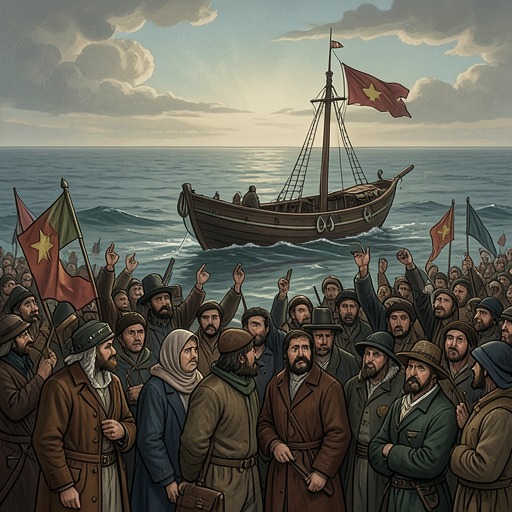
When floodwaters disperse the pilgrims in Sarang, golden butterflies guide them back to the main road, where the Ayesha Haj reforms. Muhammad Din is among the people restored to the group. Later, when the pilgrims reach the Arabian Sea, he runs into the water with the others as Ayesha, Mishal, and the villagers disappear beneath the surface. He is pulled back out, and his wife’s earlier death makes his subsequent account especially striking: in testimony to the Criminal Investigation Department, he says he saw the sea divide and the pilgrims walking away, with Khadija among them. When the investigators challenge him, he maintains that he saw what he saw.
Narrative Role
Muhammad Din’s story keeps practical care and religious conviction in uneasy relation. He helps make Ayesha’s command actionable, but his wife’s death leads him to accept a sceptic’s hospitality; he later assists the pilgrims and the bereaved even as his own position has changed. At the sea, his testimony does not resolve whether the crossing was a miracle or a vision. Instead, his insistence preserves the novel’s uncertainty: the man who could not maintain the march’s absolute belief nevertheless claims to have seen its promised wonder, and the wife he buried on the road appears in the account he refuses to retract.